I had some business to attend to in Pretoria today and on my way back I popped in to the Voortrekker Monument for a quick visit.
Photographing the monument presents a few challenges. There are always visitors in the frame, the light is bad and there are conflicting sources of light causing crazy colour casts in certain images. You also need very wide lenses and these themselves give distortions which can be arty, but not always liked by all.
The idea of building the Voortrekker Monument in honour of the Voortrekkers was first discussed on 16 December 1888 when President Paul Kruger of the South African Republic attended the Day of the Covenant celebrations at Blood River in Natal. However, the movement to actually build such a monument only started in 1931 when the Sentrale Volksmonumentekomitee (SVK) (Central People's Monuments Committee) was formed to bring this idea to fruition.
Construction started on 13 July 1937 with a sod turning ceremony performed by chairman of the SVK, Advocate Ernest George Jansen,
on what later became known as Monument Hill. On 16 December 1938 the
cornerstone was laid by three descendants of some of the Voortrekker
leaders: Mrs. J.C. Muller (granddaughter of Andries Pretorius), Mrs. K.F. Ackerman (great-granddaughter of Hendrik Potgieter) and Mrs. J.C. Preller (great-granddaughter of Piet Retief).
The Monument was inaugurated on 16 December 1949 by the then-prime minister D. F. Malan. The total construction cost of the Monument was about £ 360,000, most of which was contributed by the South African government. Physically, the Voortrekker Monument is 40 metres high, with a base of 40 metres by 40 metres.
A large amphitheatre, which seats approximately 20,000 people, was erected to the north-east of the Monument in 1949.
The Cenotaph,
situated in the centre of the Cenotaph Hall, is the central focus of
the monument. In addition to being viewable from the Hall of Heroes it
can also be seen from the dome at the top of the building, from where
much of the interior of the monument can be viewed. Through an opening
in this dome a ray of sunlight shines at twelve o'clock on 16 December
annually, falling onto the centre of the Cenotaph, striking the words
'Ons vir Jou, Suid-Afrika'. The ray of light is said to symbolise
God's blessing on the lives and endeavours of the Voortrekkers. 16
December 1838 was the date of the Battle of Blood River, commemorated in South Africa before 1994 as the Day of the Vow.
The Cenotaph Hall is decorated with the flags of the different Voortrekker Republics and contains wall tapestries depicting the Voortrekkers as well as several display cases with artefacts from the Great Trek.
 |
| A different from the norm view of the monument. |
 |
| Mother
and Children statue - Anton van Wouw's bronze sculpture of a
Voortrekker woman and her two children, paying homage to the strength
and courage of the Voortrekker women. |
 |
| The traditional view. |
 |
| Inside the main chamber with the open center looking down on the cenotaph. |
 |
| A unique marble Frieze circles the inside walls of the Voortrekker
Monument. In bas-relief, 27 panels depict the story of the Great Trek
from 1835 to 1852. |
 |
| The Cenotaph chamber with the cenotaph in the center. |
 |
| Looking up from the cenotaph one can see the hole in the roof where the sun shines through and falls onto the cenotaph on the 16th December every year at 12 noon. |
 |
| One of the many beautiful tapestries, this one depicting the Battle of Blood River. |
 |
| Looking down from the top of the monument onto the cenotaph. A chevron pattern on the floor of the Hall of Heroes radiates outwards like 32 sun rays. |
 |
| Some lovely light and patterns over the staircase leading up to the top or the monument. |
 |
| Patterned windows from the outside |
 |
| The Promise. |
 |
| The wall surrounding the monument depicts the 64 wagons in a circle (laager) like they were during the Battle of Blood River. |
|
|
Fort Schanskop
Fort Schanskop is in the same complex as the Voortrekker Monument. It was built to protect Pretoria from an attack from Johannesburg. The fort was built at a cost of GBP
£47,500 and was handed over to the government on 6 April 1897. It was
supplied with a paraffin engine powered generator for electricity,
electrical lighting and a search light. A telephone and telegraphic
links were also installed. Water was supplied from a pump station in the
Fountains Valley which was shared with the nearby Fort Klapperkop.
The garrison was initially armed with one officer and 30 men and was armed with 37 mm Maxim-Nordenfeldt cannon, Martini-Henry hand-cranked Maxim machine guns and a 155 mm Creusot gun
. By October 1899, only 17 men were still stationed at the fort.
Both the garrison and the armaments were gradually reduced during the
course of the Second Anglo-Boer war until there was only one man and no
guns left over on 5 June 1900, the day on which British forces occupied
Pretoria.
 |
| The view of Pretoria from the fort. |
 |
| The 155 mm Creusot gun, |
 |
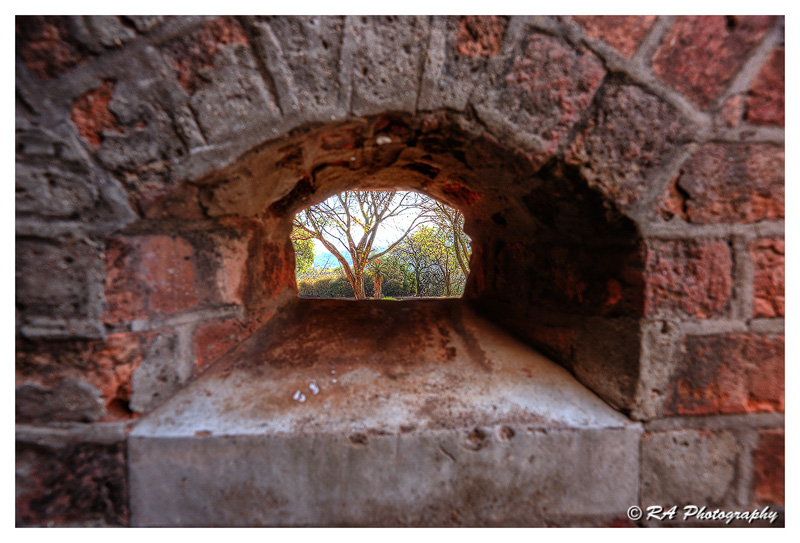
| A sighting hole in the forts' wall. |
 |
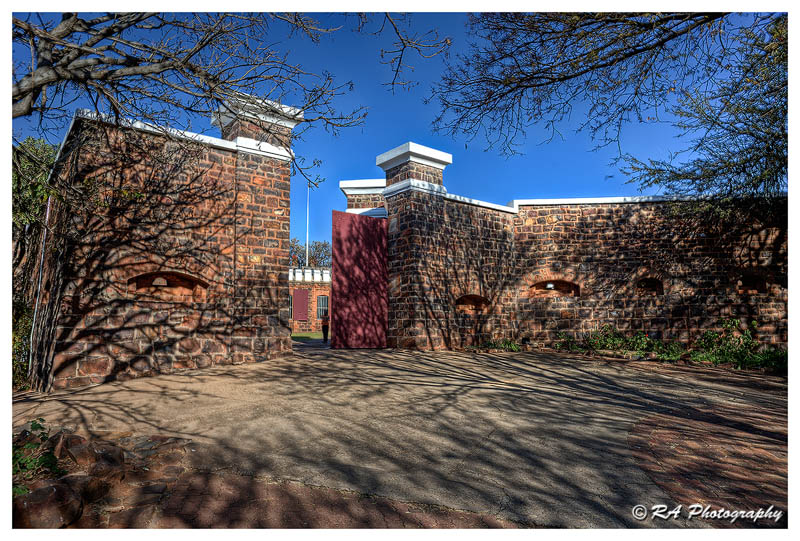
| The main gate to the fort. |



+copy+800.jpg)
+copy+800.jpg)
+copy+800.jpg)

+copy+800.jpg)
+copy+800.jpg)
